Reviews:
The Chicago Tribune
Talkin' Broadway
The Chicago Sun Times
`Whistle' fails but sounds masterful
Chicago Tribune
By
Michael Phillips
Tribune theater critic
August 29, 2005
There's a parade number in "Anyone Can Whistle" (1964),
a sardonic echo of the parade number in "Hello, Dolly!"
Beyond that the shows have nothing in common: "Hello, Dolly!"
contains no songs about phony miracles or rampant hypocrisy or lyrics
wedded to a story preoccupied with conformist consumerist soul-sucking
societal strictures. Unless you count "Put On Your Sunday Clothes."
"Anyone
Can Whistle" is the anti-"Dolly," as well as one
of the most celebrated musicals in Broadway flopdom. It is unlikely
ever to receive a successful fully-staged revival. Yet Stephen Sondheim's
score bristles with invention, and despite librettist Arthur Laurents'
addle-headed conception, the result is well worth hearing in a tiptop
concert version.
Which brings
us to the tiptop concert version performed over the weekend at Ravinia.
This was the fifth annual Sondheim score to be showcased here, and
the third featuring Audra McDonald -- performing with optimum polish
and fire, as if she'd been rehearsing for months -- alongside the
better-than-ever Patti LuPone, as well as the distinctively off-center
Michael Cerveris. Again these three were backed by musical director
and Sondheim veteran Paul Gemignani, this time leading a 22-piece
orchestra.
The score contains
one of Sondheim's loveliest ballads, "With So Little To Be
Sure Of," sung by Nurse Fay Apple (McDonald), keeper of the
"cookies" residing in a small town asylum for the "socially
pressured," and her nonconformist knight in seersucker, J.
Bowden Hapgood (Cerveris, wearing a ridiculous wig).
It contains
"Come Play Wiz Me," an irrestistible comic number for
the lovers. And the show begins -- audaciously -- with "Me
and My Town," in which the town's corrupt mayor, Cora Hoover
Hooper (LuPone, dressed in appalling pink and looking like her own
drag queen), delivers a nightclub number in the style of Kay Thompson
and les boys. For reference, check out Judy Garland's "Great
Lady Has an Interview" number from the film "Ziegfeld
Follies"; Thompson wrote its lyrics and helped arrange it,
and the results drip with finger-snapping jive, gleefully mined
by Sondheim.
At Ravinia,
LuPone and Cerveris worked varying wonders with the brittle camp
and idealistic hogwash, respectively. McDonald worked wonders with
both the comedy and the idealism throughout, va-vooming around to
beguiling effect in "Come Play Wiz Me," lending a plaintive
ache to the title tune.
John Mahoney
handled the narration with friendly aplomb and director Lonny Price
handled the traffic efficiently.
In a pre-show
talk composer/lyricist Sondheim mentioned "Bounce," seen
at the Goodman Theatre in 2003. He and John Weidman may go back
to an earlier version. "If we're going to fail," he said,
"we're going to fail on our terms."
Time, meanwhile,
has confirmed the beliefs of skeptics and fans regarding "Anyone
Can Whistle." The show still doesn't work. And the score still
sounds like the work of a master.
----------
Anyone Can Whistle
Ravinia Festival
Talking Broadway
August 29, 2005
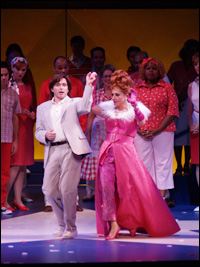
Photo by Jim Steere : Michael Cerveris, Patti
LuPone and Company
In April 1995, Anyone Can Whistle was rescued from oblivion through
a high profile, one-night-only benefit concert performance at Carnegie
Hall. Bernadette Peters, Scott Bakula and the late Madeleine Kahn
headlined alongside narrator Angela Lansbury. Since then, it has
been performed only a few times per year, mostly by schools or Sondheim-enthusiast
regional companies. Considered a problematic show because of its
book (by Arthur Laurents), Whistle has never received a major theatrical
revival, nor was it included in the Kennedy Center’s 2002
Sondheim Celebration retrospective. The August 26-27 production
this past weekend by the Ravinia Festival was the first since the
Carnegie Hall event to feature a high-wattage cast. With Audra McDonald
singing Fay, Michael Cerveris as Hapgood and Patti LuPone as Cora,
under the musical direction of Paul Gemignani and with Sondheim
himself in attendance, Whistle’s underrated score received
a historic performance, ranking alongside those of the original
Broadway and Carnegie Hall casts. What distinguished it from the
earlier casts is that the leads of this production are all legitimately
singer-actors while most of the previous leads (Harry Guardino,
Lee Remick, Ms. Lansbury, Ms. Kahn and Bakula) can fairly be called
singing actors. As in Ravinia’s four previous Sondheim productions,
performance of the music was the first priority.
Audra McDonald,
who can apparently win Tony Awards without breaking a sweat (four
of them to date), delivered a performance in this show that would
surely win her a nomination if she had performed it on Broadway.
Her determined, principled and lonely Nurse Fay Apple delivered
her big “long and loud” monologue with power and humor,
following it with a hopeful “There Won’t Be Trumpets”
that confirmed our expectations for a very special evening. McDonald
used her comic gifts to good effect when Fay poses as a French inspector
and attempts to seduce Cerveris’ character in “Come
Play Wiz Me,” and shortly thereafter broke our hearts with
the title song.
Cerveris, whose
stature as premier Sondheim leading man was established by his Tony
win for Assassins and his television performance
in Passion, holds on to his crown quite easily
with this performance. Refreshingly, we got to see him play a happy
and well-adjusted if legally insane character this time, rather
than one of the tormented souls of Assassins, Passion, and Sunday
in the Park with George. Sporting a Mike Meyers look-alike wig,
Cerveris goes positively goofy as Hapgood, having fun with “Simple”
while delivering a relaxed but sincere rendition of “Everybody
Says Don’t” - the song popularized by Barbra Streisand
which along with the title number may be two of the best songs ever
written for the musical theater. Cerveris found a way to make this
underwritten character work. He avoided the temptation to make Hapgood
a latter-day Harold Hill or any type of traditional leading man,
but instead a warm and funny scamp who relishes the opportunity
to make mischief for the corrupt Mayoress Cora Hoover Hooper and
her coterie of scoundrels. Vocally, he had a tonal color and a confident
delivery that certainly surpassed the recorded performances of the
vocally stressed Harry Guardino on the Original Cast Recording and
the perfectly fine singing-actor performance by Bakula at Carnegie
Hall.
Ms. LuPone,
who surprised many with the intensity of her Fosca in Passion (which
originated at Ravinia before its nationally-televised reprise at
Lincoln Center), got to sing and dance the sort of loud, brassy
and comic role with which we tend to associate her. “Me and
My Town,” with Cora accompanied by four tuxedo-clad “boys,”
was an homage to the nightclub acts of Kay Thompson, a popular nightclub
singer of the late ‘40s and early ‘50s whose songs Sondheim
pastiches in some of Cora’s numbers. Whistle gives her a bunch
of fast and funny numbers – “The Miracle Song,”
in which she sings and dances the ensemble in celebration of the
her faked miracle; and “I’ve Got You to Lean On,”
another nightclub style number sung with the corrupt city government
officials Schub, Cooley and Magruder. LuPone belted out the brassy
“A Parade in Town” – a song that is pure Sondheim
in its ironic juxtaposition of Cora’s resentment at Hapgood’s
usurping of her popularity with a peppy, major-key march. LuPone
and McDonald slyly played up the duplicitous tendencies of female
relationships with “There’s Always a Woman,” in
which Cora and Fay complain and plot against each other while being
all sweetness on the surface. It seems Ms. LuPone could have been
even more of a clown and found greater irony in her pompous Mayoress,
but vocally, she delivered the goods in a part that’s perfect
for her.
Director Lonny
Price packaged all this in an energetic and zany production, using
a color scheme of red, white and blue (in designs by costumer Tracy
Christensen, lighting by Kevin Adams and sets by James Noone) that
established a visual feel akin to that of a political cartoon. An
ensemble of thirty-three, all members of Ravinia’s Sandra
K. Crown Program for American Musical Theater, provided rich choral
work and slickly performed the ample and inventive choreography
of Marla Lampert. Price had the 22-piece orchestra on stage right,
leaving the remainder of the stage available for the fully staged
production he delivered.
It would be
hard to find many who would say that Anyone Can Whistle ever works
very well dramatically, though, and for a variety of reasons this
production probably won’t do much to enhance its reputation
as a piece of theater. Its story – in which a corrupt local
government of a bankrupt town fakes a miracle to attract tourism
– is all over the board in the targets of its satire. While
there’s a recently revised script (by Laurents and Michael
Michetti) that was developed for a 2002 Los Angeles production that
is a little tighter and clearer, the truncated concert script used
here does little more than set up the songs. (The narration included
in the concert version added little, in part due to the apparent
lack of preparation by narrator John Mahoney. He did better on Saturday
night than Friday, having had the benefit of reading the script
at least once before the Saturday performance).
Some of the
directorial concepts used here by Price only added to the confusion.
Most problematically, he casts Cora’s cohorts Schub, Cooley
and Magruder as the Marx Brothers, mimicking their voices, mannerisms
and costumes. While I’m all in favor of anything that helps
to immortalize the brilliant Marx Brothers, and while the idea may
have helped to establish a tone of zaniness for this production,
Price’s choice works against the ideas of the piece. Anyone
familiar with the Marx Brothers will know that their characters
were outsiders, anarchically attacking the establishment. Comptroller
Schub, Treasurer Cooley and Police Chief Magruder, together with
Mayoress Cora Hoover Hooper are the establishment. I would guess
that anyone who didn’t recognize the Marx Brothers would be
a little confused. For what it’s worth, though, Jerry Galante
as Cooley did a great impression of Chico. The temptation to look
to films of the ‘30s and ‘40s is understandable –
Anyone Can Whistle’s plot owes a great deal to films of Frank
Capra in which an idealistic outsider (James Stewart or Gary Cooper)
enlists the aid of a strong woman (Jean Arthur or Barbara Stanwyck)
to fight the establishment – but Price put the Marx Brothers
on the wrong team. It doesn’t help either that this show business
reference is mixed in with unrelated references to Kay Thompson
and Mike Meyers. The libretto is confused enough as it is without
complicating it further.
Price’s
idea to use the “red state/blue state” division of the
U.S. here doesn’t entirely work, either. He initially dresses
the “cookies” – patients of “Dr. Detmold’s
Asylum for the Socially Pressured” - in blue and the townspeople
in red. After the “cookies” escape and hide among the
non-hospitalized townspeople they’re all in red, so they blend
in. Hapgood, who arrives in the town and is mistakenly believed
to be a new psychiatrist, divides everyone into two groups –
“Group A” and “Group 1”. They begin to oppose
each other, but since they remain all dressed in red the comparison
to our current red and blue state rivalry is lost.
Still, one has
to admire Price’s ability to make concert presentations that
are so satisfying musically, but also succeed so well as theatrical
pieces. We also acknowledge that the constraints of one or two-night
events like these concerts don’t allow the opportunity to
try out ideas in front of an audience before opening the show to
the media.
Judging from
comments made by Sondheim and Ravinia CEO Welz Kaufman at a public
talk before the Friday night performance, it seems a safe bet that
the Sondheim series, originally planned to conclude with this production,
will continue for the foreseeable future. Let’s hope they
do. After starting with a restaging of the LuPone/George Hearn Sweeney
Todd that Kaufman produced while he was at the New York Philharmonic,
Ravinia has given us an additional four original productions that
have been truly remarkable. They followed Sweeney with an exceptional
Night Music featuring LuPone and Hearn as well as Zoe Caldwell and
Marc Kudisch, that must surely rank among the finest productions
of the piece ever. The third year’s show, Passion, has had
a life after Ravinia, with its PBS telecast earning acclaim and
probably recognition as one of the best interpretations of the piece.
Last year’s Sunday in the Park with George was an amazing
demonstration of its score’s strength. This year’s production
of Anyone Can Whistle was another one for the history books. It
should be preserved, at least through an audio recording, so a wider
audience can hear the brilliant score sung by such brilliant singers.
Anyone Can Whistle
was performed at the Ravinia Festival, Highland Park, Illinois on
August 26 and 27, 2005.
'Whistle' woes
notable, but McDonald's a treasure
The Chicago Sun Times
By
Hedy Weiss
August 29, 2005
If you want
to convince an audience that a particular musical is a whole lot
better than it really is, you need do nothing more than call on
Audra McDonald -- not just the most glorious singer now at work
in the theater but a sensational actress, and a performer at the
very peak of her astonishing powers. McDonald might not be able
to solve all of the show's considerable problems, but she sure can
divert attention with her blazing emotional fire, vocal beauty and
total commitment.
Those who packed
the Ravinia Festival's pavilion this weekend for two staged concert
performances of Stephen Sondheim's "Anyone Can Whistle"
-- the fifth (and perhaps not final) season of the "Sondheim
75" project -- will need no convincing about McDonald. But
they might add that when you deck her out in a red, spaghetti-strap
gown that hugs every curve, toss on a sleek, Josephine Baker-style
wig and perch her atop a pair of stylish retro heels, you not only
give her added ammunition, you make almost everyone else onstage
seem like supporting characters. And the "everybody else"
in this case included such formidable presences as Patti LuPone,
Michael Cerveris and John Mahoney (as narrator), all of whom were
superb.
Even in a prim
blue-and-white uniform, McDonald, who plays the highly disciplined
psychiatric nurse, Fay Apple, can (and did) stop the show, whether
diving into a maniacal monologue about her own willful single-mindedness
or blowing the stuffings out of Sondheim's heraldic song, "There
Won't Be Trumpets," a clarion declaration for the anti-romantic
dreamer. But it's in that vampy red dress, as she tried to make
a connection with the brilliant but eccentric outsider, J. Bowden
Hapgood (Cerveris), that McDonald sealed the deal -- first with
the French-accented "Come Play Wiz Me," all playfully
sexy insinuation, and then, when returned to her character's true,
over-controlled self, with the musical's title song, a heartbreaking
example of self-analysis.
"Anyone
Can Whistle," which debuted on Broadway in 1964, was Sondheim's
second major music-and-lyrics project, and the more you hear the
score, the more there is to admire, especially when it is sung as
superbly as it was here, and with veteran Sondheim musical director
Paul Gemignani and the Ravinia Festival Orchestra in a vibrant,
nuanced, passion-packed performance.
But from the
start the show's problem was its book (by Arthur Laurents). A hodgepodge
of sophomoric rebellion that compares and contrasts the corrupt
nutcases running a small-town city hall with the patients and staff
of the local mental institution, it comes to the not very earth-shattering
conclusion that there is little difference between those on the
outside and those on the inside of such places.
To be fair,
the book has a few bursts of smart comic writing. But a narrated
concert version is definitely the way to go with this show, eliminating
at least some of the mind-numbing cuteness of scenes in which inmates
of the Cookie Jar parade around town in the same kind of stupor
as its "normal" inhabitants. Director Lonny Price -- in
his fifth edition of the Ravinia Sondheim series -- quickened the
pace all around, and found a way to intensify the fractured love
story at the heart of the show.
James Noon's
comic book-like set, in bright red and blue (as clearcut as a current
U.S. electoral map), was perhaps less politically charged than the
fact that this tale of city corruption arrived onstage at the very
same moment that our own mayor was being visited by the Feds.
As Mayor Cora
Hoover Hooper, Patti LuPone (the role originated by Angela Lansbury)
was all brash and bristling infallibility in her 1950s cerise satin
cocktail hour garb. Winningly jazzy (with a Latin undertow) in "Me
and My Town," she lead the gospel roof-raiser "Miracle
Song," and "There's a Parade in Town." And she and
McDonald revealed all their claws in the competitive catfight song,
"There's Always a Woman."
LuPone also
had some playful byplay with her city servants, who Price neatly
turned into the Marx Brothers (with particularly zesty work by Ray
Wills, as a Groucho-like comptroller). As for Cerveris, who will
play the demon barber Sweeney Todd on Broadway
this season, he could not have been more charming. Looking startlingly
different in a shaggy wig, he was a sweet, offbeat foil for McDonald's
seriousness, bringing an especially lovely, childlike quality to
"Everybody Says Don't."
But then there
was McDonald to capture to perfection the aching sense of love and
loss in "With So Little to Be Sure Of." One thing you
can always be sure of is that McDonald will prevail.
'ANYONE CAN WHISTLE'
AT THE RAVINIA
FESTIVAL
|
