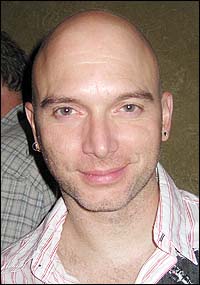
 photo
by Aubrey Ruben photo
by Aubrey Ruben
The first Broadway musical Michael Cerveris saw was the original
Sweeney Todd, The Demon Barber of Fleet Street.
The actor now
becomes the titular "proper artist with a knife" for a
unique revival of the Stephen Sondheim musical — and gets
to put his hitherto unexploited guitar skills to good use on stage.
(The last time Cerveris played one of Sondheim's notorious killers,
Assassins' John Wilkes Booth, it earned him a Tony Award.)
"Sometimes
you're telling the story with your voice and sometimes you're telling
the story with your fingers," explains Broadway's newest Todd
about the new John Doyle staging which uses an ensemble of 10 actors
who act, sing and perform the score on varying instruments —
most without sheet music in front of them.
Cerveris spoke
with Playbill.com about the rigorous rehearsal process, the show's
new conceptual take and how Sondheim has ruined him for traditional
music theatre composers.
Playbill.com:
Is this a role you've been looking forward to, having performed
so much Sondheim?
Michael Cerveris: I get asked the question, from time to time, "Is
there a role you always wanted to play?" and I usually say
no because I haven't ever been one of those people who maps out
what they want to do. And yet, I think if there was a role I would
have said that of — it would have probably been this one.
It's probably largely because Sweeney was the first Broadway show
I ever saw. I saw the original company in previews, actually, and
then went on to see it another six times with Len [Cariou] and with
George Hearn [in the title role].
I would come
down on weekends from school. To me, Len Cariou, because he was
the first one that I saw, was the epitomy of the male musical theatre
actor. I was equally blown away by George Hearn too, but I guess
because I had seen Len first, you know, [in a theatre fanatic voice]
you never forget your first Sweeney. Also because it was such an
actor's performance, he was a terrific singer but what I really
found compelling was the acting side of it. I think Sweeney has
always kind of been my Hamlet. But I didn't necessarily think I
would do it.
Playbill.com:
Even with all your Ravinia Festival "Sondheim 75" performances?
[Cerveris starred in Passion, Sunday in the Park with George and
Anyone Can Whistle at the multiple-year celebration at Ravinia near
Chicago.]
MC: I supposed if it was going to happen, it would be several years
down the line still because traditionally it has been played by
older actors. Technically, Sweeney should be in his mid-30s to mid-40s
because he was probably in his 20s when he and his new wife has
the first child very young. Then he's sent away for 15 years and
comes back as far as the story goes. But I guess also because I
never expect anything to happen [Laughs].
Playbill.com:
You've performed in a number of Sondheim musicals, does it get any
easier?
MC: I do have to say that being in Steve's musical universe becomes
more and more... I wouldn't want to say "second nature"
because that implies that it starts to get easy. It just sort of
makes sense, the more you do it, the more you get familiar with
the tonal palate, with the rhythmic changes and the key signature
changes and the tempo changes and things; even though he varies
a great deal from piece to piece. That's one of the things that's
so amazing about him is the way he writes different kinds of music
for different kinds of characters in different kinds of shows. That
was the amazing thing about the Washington, D.C. [Kennedy Center]
Sondheim Celebration because back to back you would see Company
with this swinging 60s-70s, jazzy band kind of score and then you'd
see Sweeney Todd the next night. And you'd see little things that
thematic or musically would carry over from one to the other, but
you would also think, "How could these things both have been
written by the same guy?"
But there is
a way that the more you do it, the more you go "Oh right, of
course." If it seems like it's the normal, natural interval,
it's got to be wrong [Laughs]. It can't be Sondheim. I did a workshop
of [Harvey Schmidt and Tom Jones'] 110 in the Shade and I couldn't
figure out how to sing it because it was so normal. I hadn't sung
anything quite normal in a long time and I really had a hard time
readjusting. I was saying I think Sondheim has made me unfit for
any other kind of musical singing.
Playbill.com:
Once you go Sondheim...
MC: Exactly.
Playbill.com:
Being that the actors are all playing instruments while singing
and acting, what was the rehearsal process like?
MC: It was the most exhausting rehearsal process I've ever had and
the most exhilarating. We worked longer than usual hours —
also because [director] John [Doyle] comes from the British tradition
where you generally take a full weekend off (Saturday and Sunday).
So we worked extra hours in the week to make up for the fact that
we were going to have two days off, which was such a fantastic way
to work because then you truly get some time to rest and process
everything you learned during the week and work on your own.
It was just
a huge amount of repetition. I very seldom had the energy to do
work at home at the end of the day, but you did so much work in
rehearsal and so much repetition, that you would actually memorize
stuff just by going over it and over it. And you would discover
that you had learned things already.
Playbill.com:
So were there separate musical rehearsals?
MC: A typical day we'd start with a group vocal warmup led by one
of our two music directors, either Sarah Travis or David Loud; which
was great, I haven't had a group vocal warmup in a show since school
probably. And so much of it felt like school in that way; back to
basics and back to just being open and creative. So we'd start off
and we would do a section of the story we had staged already and
we would sort of go back to some previous point and we would carry
on up to as far as we knew. Then we would make some corrections
and go back and run through it again a couple of times.
Playbill.com:
With musical instruments, blocking and all?
MC: Yes, everything was all done at the same time. As we moved forward
into the next section we hadn't staged before, we would have rehearsed
the music for that the day before. So the early part of the day
would be reviewing and getting another chunk of the play up on its
feet and then John would turn it over to Sara and David and we would
have music rehearsal for a couple of hours to learn the music for
the next section. Then once we had everything done, we went back
to the beginning and started the whole process again like we hadn't
done it. John was also constantly revising and refining the storytelling
and then we would have music cleanups and music reviews. There were
sometimes occasionally, like if John was working with Patti [LuPone,
who stars as Mrs. Lovett] and I on a dialogue scene that didn't
involve music, sometimes we would rehearse those scenes with just
an accompanist. But more often, we would do dialogue scenes and
then everybody else in the company could be working on music. That
tended to happen more with Patti and I being separated because our
instrumental responsibilities aren't as great.
Playbill.com:
Watching the show, you realize everyone is completely off-book musically
because there's no sheet music on stage with the exception of the
book by the keyboard.
MC: Yes, the piano music is left on stage, it's the only music that's
on stage. And it's really not even there so much [for reference],
they all know the piano parts now, it's just everyone thought, if
worse comes to worst, somewhere on the stage there ought to be a
score. If somebody's cello string broke or something happened to
one of the instruments and they couldn't be played, then at least
the pianist could fill in that part. And then because there's that
overarching idea that this is kind of a therapy session for Toby
in which all the other inmates are going to act out the story. So
if there's somebody flipping music pages, it kind of contributes
to that idea.
Playbill.com:
There is no conductor, and very few noticeable cues besides the
show's first number beginning after a sniff by actress Donna Lynne
Champlin. Is that another product of the repetition?
MC: Yeah, when things come out of nowhere and need to be cued, people
are either sniffing or [lifting] eyebrows. We've now gotten pretty
good at playing as a unit. The intention is never to fool the audience
into thinking that there's something perfect going on. The whole
joy of it is that you're seeing it all happen right in front of
you. And I know it's hard to believe that all the sound is coming
from what you're looking at, but there's nothing offstage that's
being played, nothing being done to digitally enhance anything.
Playbill.com:
How will understudies come into play?
MC: It's trickier now because when they cast the first bunch [of
actors], not everybody in our production is playing the same instruments
that were played by their predecessors in the London production.
But, if they found somebody who did play something else and someone
else in the company could play what that person played, it was okay.
But now that it's set, it's going to be cello-playing Johannas,
[etc.]. ...They made the aesthetic decision that they always wanted
everything you're hearing to be coming from what you're seeing.
They didn't ever want to give the impression that we were hiding
an orchestra behind the set. So casting for understudies now just
requires insanely talented multi-disciplined people.
Playbill.com:
And praying that nobody gets sick.
MC: Well, yeah, exactly. Not to mention, that no of us ever wants
to be out.
Playbill.com:
In addition to the casting of only 10 actor-musicians, Doyle employs
a new conceptual take on the work [the show is presented in an asylum],
do you think Sondheim fans — who may have the original Angela
Lansbury-Len Cariou/George Hearn production etched into their memories
— will not easily accept this?
MC: I would say anyone who is a true Sondheim fan would respond
to it, if only because Sondheim himself loves it. He thought so
highly of it when he went to see it to approve its transfer to the
West End, he actually said 'if it's going to be revived in the States,
this is the production I want revived'; he couldn't give a more
authoritative endorsement. So, anybody who calls themselves a true
Sondheim fan I would think would respect the author's wishes.
But I know there
are fans of that original production, as I am — I'm a huge
fan of that original production. It was a very formative experience
for me. But, just as there's not a single way to produce Hamlet,
there's not a single way to produce Sweeney Todd. It's as remarkable
a piece of theatre literature as anything. I think the most important
thing is to come with an open mind and relinquish the things you
think you know about it or the things you think have to be true
about it. And really, what's the point of reviving something, if
you're just going to recreate what was done so wonderfully before.
Unless it's just your own ego because you wanted to be in that production
and never got to be, so now you want to do it 20 years later which
is often what it looks like. Some revivals seem to be driven by
that. But this is revisiting the original source material and expressing
it in a new way, not just to be new, but to tell this story in a
different way today.
Playbill.com:
All the original musical numbers are in the production, were there
any cuts in dialogue?
MC: Minimal, nothing that would really stand out. Occasionally,
there's a verse taken out here or there. Sondheim has also rewritten
some lyrics to accommodate the particular staging requirements of
this production. Which again is a testament to his belief in it;
that he's volunteered to go in and make it even better. There might
be a line trimmed here or there or a word changed to make more sense,
but it's pretty much the Sweeney we all grew up loving.
|
