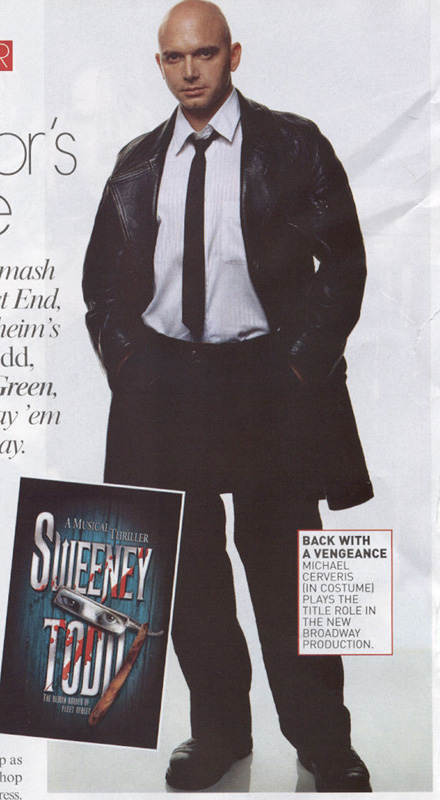
 (Photo
Michael Cerveris in costume) (Photo
Michael Cerveris in costume)
About ten years
ago, the Scottish born theater director John Doyle found himself
in Liverpool on the horns of a dilemma. His budget for a production
of Leonard Bernstein's Candide was large enough to pay for either
a cast or an orchestra but not both. So Doyle came up with a novel
solution- hire actors who play instruments and in the process, stumbled
on a fresh approach to musical theater. Since then, his intimate
reinterpretations of such well known works as Pal Joey, Cabaret
and Fiddler on the Roof, performed by small casts of actor-musicians,
have won high critical praise. This month, New York audiences can
have a look at what Doyle has been up to, as his radical take on
Sweeney Todd, Stephen Sondheim's bloody 1979 masterpiece, arrives
on Broadway.
Adapted by Stephen Sondheim and Hugh Wheeler from a Christopher
Bond play based on a nineteenth-century penny dreadful villian,
Sweeney Todd was almost certainly the first Broadway musical about
serial murder, cannibalism and rape. Under the imaginative direction
of Hal Prince, it was epic in scope and depicted a Dickensian London
being crushed into the jaws of the Industrial Age. The musical itself
tells the story of a once decent man who returns from unjust exhile
in Australia, seeking revenge on the corrupt judge who destroyed
his family and his life. Twisted by grief and rage, he remakes himself
as The Demon Barber of Fleet Street, a self-appointed executioner
whose unlucky customers receive the ultimate in close shaves and
wind up as lunch specials at the pie shop run by his enterprising
mistress.
What lifts Sweeney Todd above pure melodrama of course is Sondheim's
passionate, almost operatic score, perhaps the finest ever written
for the American stage. The music is emotionally varied, and psychologically
acute, sharp dissonances and lush melodies are woven together by
unsettling themes that pay homage to Hitchcock composer Bernard
Hermann. The virtuso brilliance of the lyrics is unmatched. Sondheim,
who remains a cultural titan rather than a box office king, largely
because of his compulsion to explore the dimly lit corners of the
human soul, found Sweeney Todd's combination of horror, black comedy
and ruinous obsession irresistable. "I wanted to really scare
audiences but to do it in a way that didn't let them keep him at
arm's length." he says.
Doyle aims to draw the audience closer still. The spare set, designed
by the director to suggest a nineteenth century operating theatre
is dominated by a coffin, buckets of blood, and shelves lined with
surgical tools, specimen jars, and other creepy memento mori. The
evening begins with an invitation to "attend the tale of Sweeney
Todd." sung by a lad who has just been released from a straightjacket.
He is joined by the rest of the nine member ensemble, costumed by
Doyle, not as Victorian caricatures but as contempory urban types.
With cello, horns and flutes, the cast remains onstage throughout
the evening- acting, playing music or just watching. "Without
an orchestra, there is nothing physically between the audience and
the actors, which creates a feeling of being in this together."
Doyle says. "The instruments are the characters' voices in
a sense - extensions of their emotional world."
On acoustic
guitar - as the murderous barber himself is Michael Cerveris, a
2004 Tony winner for his haunted John Wilkes Booth in the superb
revival of Sondheim's Assassins. Cerveris brings to the stage a
smoldering rock-star intensity which is honestly come by: He has
toured as a guitarist with Husker Du's Bob Mould, and he still plays
gigs around the city with his own band. The 45- year old West Virginia
native started his performing career in junior high, as the front
man for a Deep Purple knockoff whose look he describes as "platform
shoes, elephant bells and way too much hair". Then on a trip
to New York with his parents when he was eighteen. Cerveris saw
his first Broadway show- Sweeney Todd. He returned seven times and
wore out his copy of the original cast album.
"I recently told Steve that I thought he was the real rock'n'roll
composer." Cerveris says. "I couldn't quite tell his reaction
to that. To me, his work has that kind of groundbreaking, take no
prisoners passion and swaggering disregard for convention."
Sondheim's score gives Cerveris ample opportunity to prove his thesis,
particularly in the act one head banger -"Epiphany" during
which Sweeney slashes the air with his razor before wheeling on
the audience and growling. "How about a shave?" It is
Sondheim's exclusive genius that he can create a moment that his
both ugly and profoundly exhilarating, and that he can follow it
with a sublimely funny music hall duet about cannibalism that stops
the show.
Cerveris's partner in crime in that number is Patti LuPone, who
as the eminently practical Mrs. Lovett, has hit on a cheap replenishable
source of meat for her pies. Among other offerings she promises
"shepherd's pie peppered with actual shepherd." This is
not LuPone's first outing as Mrs. Lovett (she costarred with George
Hearn in a 2001 concert that was aired on PBS) but it is her professional
debut on the tuba. "I was in my high school marching band,
" she explains. "We had an all girl sousaphone line -
how sexy is that?"
The diminutive actress will be hefting her instrument into a role
originated by Angela Lansbury, who played her as a coy, scatterbrained
matron with saucer eyes and a heart of steel. With LuPone, who has
made a career of portraying such shrinking violets as Maria Callas,
Eva Peron and Norma Desmond, the steel is closer to the surface.
"Steve told me that she's the true villian of the piece because
she's so pragmatic," LuPone says. "IT's all business for
her. She wants money and comfort and a nice home life. How she gets
it is incidental."
In the end, what separates Sweeney from Mrs. Lovett, and makes him
a tragic hero rather than a cartoon monster is his self-immolating
and all too human need for revenge. "I think everyone can identify
with the desire for revenge." Sondheim says."We can look
at what Sweeney does and know that this is not the most constructive
outlet for rage - but we know exactly where it's coming from."
|